
Fannin Three-Day Release Window
Fannin County does not publish a distinct rolling 72-hour release list in the sources reviewed. Its inmate information page does provide Inmates Sorted by Booking Date and an “Include Previous Inmates In Search” control. Set a three-day range and include prior inmates to find custody records that may no longer appear in Current Inmates. This is an archive-style search, not a discharge feed. It has no published update cadence or retention period.
The wider interval is still useful. It reduces the risk that a late-day booking, weekend court action, or delayed web update falls outside a one-day check. Yet the final evidence remains the Fannin jail record, which includes the discharge day, discharge order, and issuing court under Georgia law. A custody-change notification or receiving-agency result can help when the person left the local jail through transfer.
Check Fannin Three-Day Releases
Use the date range to build a candidate set, then confirm each departure. This method differs from the same-day check because it also uses court-calendar context and a longer comparison between current and past results.
- Open Inmates Sorted by Booking Date on the Fannin inmate page.
- Enter a date range covering the three calendar days at issue.
- Select “Include Previous Inmates In Search.”
- Compare each result with Current Inmates to see whether the local page still shows custody.
- Record the booking details, then contact the Detention Center or submit an open-records request for discharge facts.
- Use the court calendar or case office to identify the order, and check VINE or GDC if transfer is possible.
When only the current day matters, the 24-Hour Releases page gives a tighter intake-versus-release check. Neither window should be used as a substitute for the jail's discharge record.
Fannin Three-Day Record Fields
The web search and the official record hold different parts of the answer. The table keeps those sources separate so that a date filter is not mistaken for a release timestamp.
| Field | How to read it |
|---|---|
| Booking-date range | Limits intake records to the selected period. |
| Previous-inmate option | May reveal a past booking that is no longer on the current view. |
| Current custody result | Shows the status presented by the live local page when checked. |
| Discharge day | Confirms the date local jail custody ended. |
| Order of discharge | States the authority under which the person left. |
| Court issuing order | Identifies where to seek the linked case action. |
Fannin's online page does not publish an exact three-day release time, release type, or retention window. Ask for those facts rather than filling gaps from the roster. A person may also vanish from the current list after moving to another agency, which is not the same as returning home.
Fannin Weekend Release Checks
A three-day span is most helpful when ordinary office access is limited. A court order or jail processing event can occur outside the hours when a records request receives a reply. The public inmate page may also update on a different schedule from the jail's internal record. Fannin County has not published a specific weekend release timetable in the research, so no hour should be promised.
Check the current and previous-inmate views first. Then save the names, booking dates, and date range used. On the next business day, ask the jail or issuing court to confirm the discharge day and order. For one named person across custody systems, the search and records paths on the Fannin County home page distinguish local jail, GDC, federal, and immigration results.
Obtain Fannin Discharge Proof
Call the Fannin County Adult Detention Center at 706-632-2045 for a time-sensitive status question. For a record, use the Sheriff's Office open-records form. Identify the person and approximate dates, then request the commitment and discharge record, release date, discharge order, releasing court, and booking sheet. The form permits inspection or copies and cites O.C.G.A. 50-18-71.
Fees may cover search, retrieval, copying, and supervision. The first 15 minutes are not charged, and paper copies are generally $0.10 per page unless law provides otherwise. Georgia VINE is useful for a custody-change alert. GDC's Find an Offender is the right route for a former state prisoner, while BOP covers federal records. A county request cannot establish a later release from one of those separate systems.
Fannin Previous-Inmate Search
The previous-inmate checkbox is Fannin's most distinctive three-day tool. It extends the booking-date search beyond people shown as current, which helps locate a record after the live roster changes. Still, “previous” is not a release reason. It can reflect an ended booking, a transfer, or another database state, and the publisher gives no retention guarantee.
Use it as a bridge, not a conclusion. Capture the booking date and compare the current view. Then seek the statutory discharge fields from the sheriff. If the person entered GDC, the state offender record becomes the next source. If a court order drove the departure, the court file gives the legal context.
Name searches also need care. Common names can produce more than one booking, and a date-range result may belong to an earlier custody event. Compare the full name, booking date, agency, and any identifying detail the page supplies. The Sheriff's Office request should describe the exact event rather than asking only whether the person has ever been jailed. A focused request is more likely to return the discharge day and order that answer the three-day question.
Fannin Release Calendar Context
The Appalachian Judicial Circuit calendar can help identify court activity near the three-day window. A calendar does not prove that jail staff completed a release, but it can point to the court and session connected with a bond, plea, dismissal, sentence, or other order.
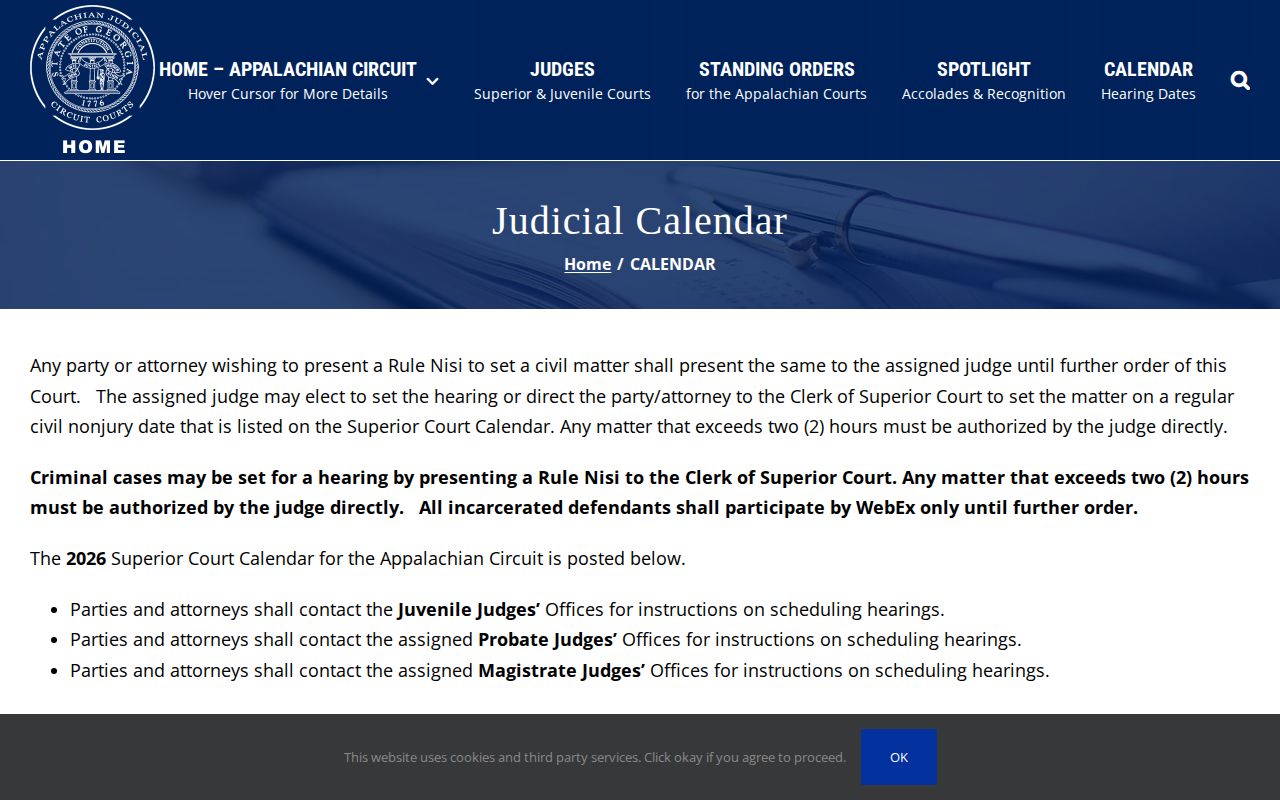
The calendar image above is best used after the roster comparison. Match any likely court event to the Fannin discharge record rather than treating a docket listing as the release itself.
Different Fannin courts explain different paths. Magistrate Court handles first appearances, warrants, preliminary hearings, and some bail decisions. Superior Court handles felony cases and appeals from Magistrate or Probate Court. Probate Court handles misdemeanor traffic and game or fish matters. A calendar entry should therefore be routed by case type, not sent to one court by default. The issuing-court field in the jail record is the best guide when it is available.
Fannin Release Destinations
Leaving the Fannin County Adult Detention Center can mean release to the community after bond, time served, sentence completion, dismissal, or another court order. It can also mean transfer to GDC after a state sentence, movement to another jail on a warrant, or delivery to an agency acting on a lawful detainer. The current inmate page does not explain that destination.
Follow the record trail that fits the event. The sheriff confirms local discharge. The court explains its order. GDC confirms state custody. VINE may note release or transfer where the feeding agency supplies it. When the person did not return to the community, the receiving agency's record is essential.
VINE is most useful when notice was registered before the expected change. Its alert can provide a time marker, but the feed may lag and the label may cover release from one facility into another agency's custody. For a completed three-day review, preserve the VINE status, compare it with the jail's discharge day, and check the destination shown by the next agency. This keeps the sequence clear even when several systems update at different times.
A federal or immigration handoff needs another branch. The Bureau of Prisons locator can show a release date or that a person is no longer in BOP custody, but it does not document a Fannin jail discharge. The ICE Online Detainee Locator covers eligible immigration custody records. Neither result should be blended with the county's three-day date range. First prove the local discharge, then use the federal system to learn whether custody continued elsewhere.
The same rule applies to another Georgia county. An outside warrant can cause Fannin to release the person to that county rather than to the community. Ask the detention center whether the departure was a transfer, and then search or call the named receiving jail. A three-day review is complete only when the next custody state is accounted for.
Note: A 72-hour search catches more records, but a wider window does not make an intake list a release list.
Public Record Search
Sponsored Results