
Fannin Scheduled Versus Actual Release
A projected date is a calculation or planning marker. The actual release is the recorded custody event after staff process all orders and holds. At the Fannin County Adult Detention Center, a pretrial detainee has no fixed sentence-expiration date. Bond, first appearance, a later court order, dismissal, or another case can decide whether and when release occurs. A sentenced county inmate has a term that may be reduced by lawful earned time.
GDC uses several distinct date fields for state prisoners. Maximum Release Date assumes the full sentence is served and excludes parole decisions. Sentence End Date is the effective end under GDC rules. A Tentative Parole Month is a Parole Board planning month, not a final release date. Life and death sentences do not have a GDC maximum release date. These terms should never be collapsed into one generic estimate.
Find Fannin Projected Release Dates
Start with the facility, because each custodian holds a different record. The local jail's public page can help identify a Fannin booking, but it is not a sentence calculator. For a county sentence, contact the jail and sentencing court. For a state-prison sentence, search the Georgia Department of Corrections offender database by name, GDC ID, or case number and compare identifying information.
- Confirm whether the person is pretrial, county-sentenced, in GDC, or in federal custody.
- For pretrial custody, check the court for bond and later orders rather than expecting a fixed date.
- For a county sentence, ask the Fannin jail and sentencing court for the term, jail credit, and public release calculation.
- For GDC custody, read the exact status and date labels on the offender record.
- Check the Parole Board TPM tool only when parole consideration applies.
- Confirm the final date and destination with the current custodian before relying on the estimate.
GDC warns that online information may be incomplete and should be confirmed in writing with Inmate Records and Information, P.O. Box 1529, Forsyth, GA 31029. The Fannin County released inmate search explains the separate county discharge-record path.
Fannin County Earned-Time Rules
County earned time comes from O.C.G.A. Section 42-4-7. It allows the sheriff, chief jailer, warden, or designated custodian to award earned-time allowances for certain county inmates based on institutional behavior. The allowances generally cannot exceed one-half of the confinement period, though the law includes different work-detail credits and exclusions. A county inmate is released at sentence expiration less awarded earned time.
This rule does not create a fixed date for a pretrial detainee. It also is not the vocabulary GDC uses for a state-prison sentence. GDC date fields can account for jail credit, non-running time, and credits under the governing corrections rules. The Parole Board separately controls parole decisions. A calculation must therefore begin with who imposed the sentence and who now holds the person.
The statute page captured for this Fannin release-date topic is shown below. It is the source for the county jail earned-time framework, not a personal sentence calculator.
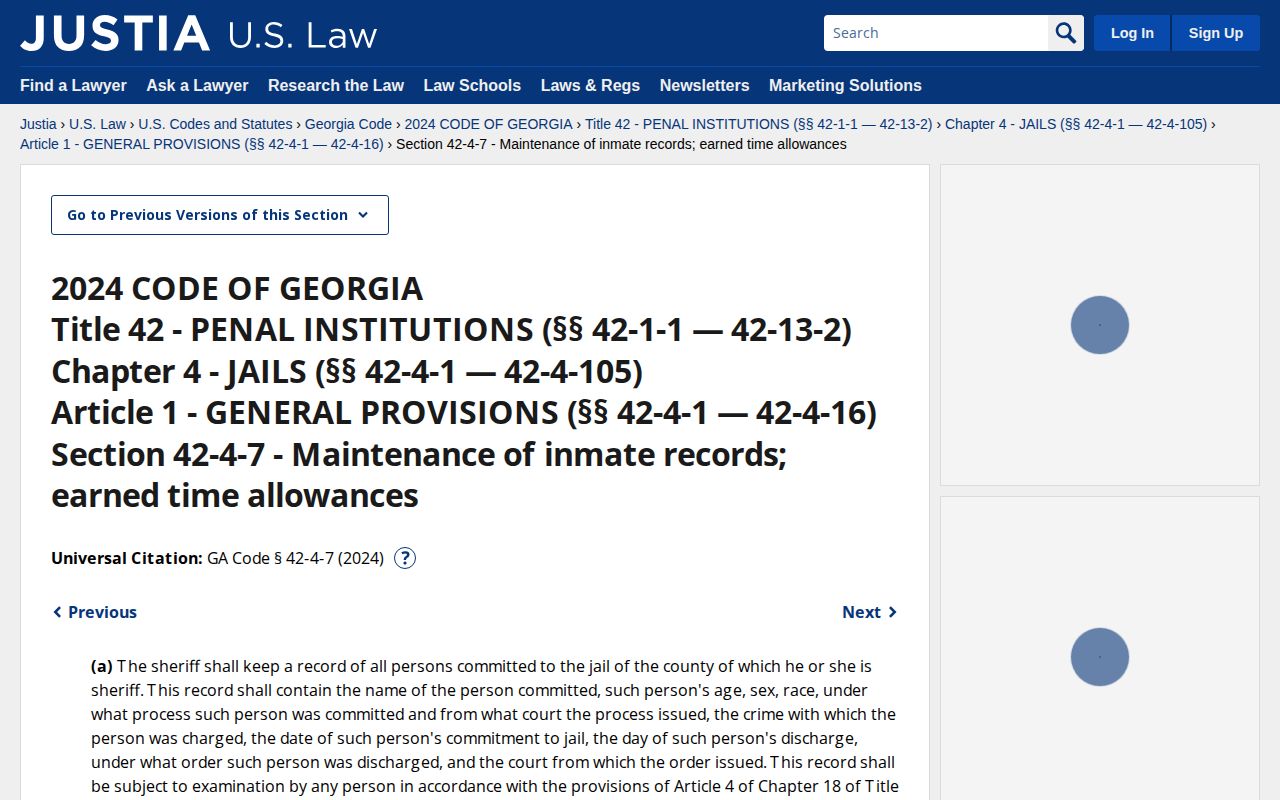
Only the jail and court can apply the governing term, credit, exclusions, and orders to a named county inmate.
Why Fannin Release Dates Change
A date can change because the underlying legal inputs change. Credits can be awarded or lost. A court can amend a sentence or issue another order. The Parole Board can set, reconsider, postpone, or deny parole. A detainer, meaning a lawful request by another authority to hold or take custody, can change where the person goes even when the current sentence ends.
| Factor | Possible effect | Source to check |
|---|---|---|
| Earned-time award or loss | Moves a county or applicable corrections calculation | Current custodian |
| Jail credit | Changes the effective sentence start | Court and GDC |
| Court order | Modifies, ends, or replaces the sentence | Issuing court |
| Parole action | Sets, delays, denies, or changes a planned release | Parole Board |
| Program or conduct issue | Can delay a TPM-based plan | GDC and Board |
| Detainer or warrant | May produce transfer instead of community release | Holding and receiving agencies |
A transfer out of Fannin custody is a county discharge event, but not necessarily freedom from custody. The receiving agency becomes the next place to check.
Confirm Fannin Release Dates
For the county jail, compare the current-inmate list with the previous-inmate search, then call 706-632-2045 or submit the sheriff's open-records form for the discharge date and authority. The public site offers a last-day booking view, not a last-day release feed. A missing current record suggests a status change but does not state whether the person went home or transferred.
For GDC, use the offender record and written confirmation when precision matters. For a pending custody change, the Fannin VINE inmate check explains how to register for alerts. VINE may report release or transfer, but the source agency supplies the final record. Federal dates belong in the BOP locator, while ICE's locator is mainly for current immigration detention.
Note: Record the field label with the date, since a TPM and a maximum release date answer different questions.
Three Fannin Release Calculations
The defining Fannin issue is that three people housed under Georgia authority can have three different kinds of date. A pretrial detainee has no sentence-expiration date. A county-sentenced inmate may have an earned-time calculation under Section 42-4-7. A state prisoner uses GDC sentence fields and may also have a Parole Board TPM. Asking only for “the release date” can produce the wrong answer.
| Status | Date framework | Best source |
|---|---|---|
| Pretrial in Fannin jail | No fixed sentence date | Court and jail |
| County sentence | Sentence term less applicable earned time | Jail and sentencing court |
| GDC state prisoner | Sentence and maximum release fields, plus parole dates | GDC and Parole Board |
This county-specific distinction comes directly from Georgia law and agency rules. It prevents a GDC maximum release date from being applied to a local jail term and prevents a TPM from being reported as final.
Fannin Tentative Parole Months
The Georgia Inmate TPM Lookup accepts an inmate number, GDC ID, or personal information. The Board explains that a TPM is the month when final review may be completed and a parole release date may be set. Good conduct and required programming can affect the result. The Board may also change a prior decision before release.
The TPM explanation is shown below because it is a frequent source of date confusion for Fannin families and record users.
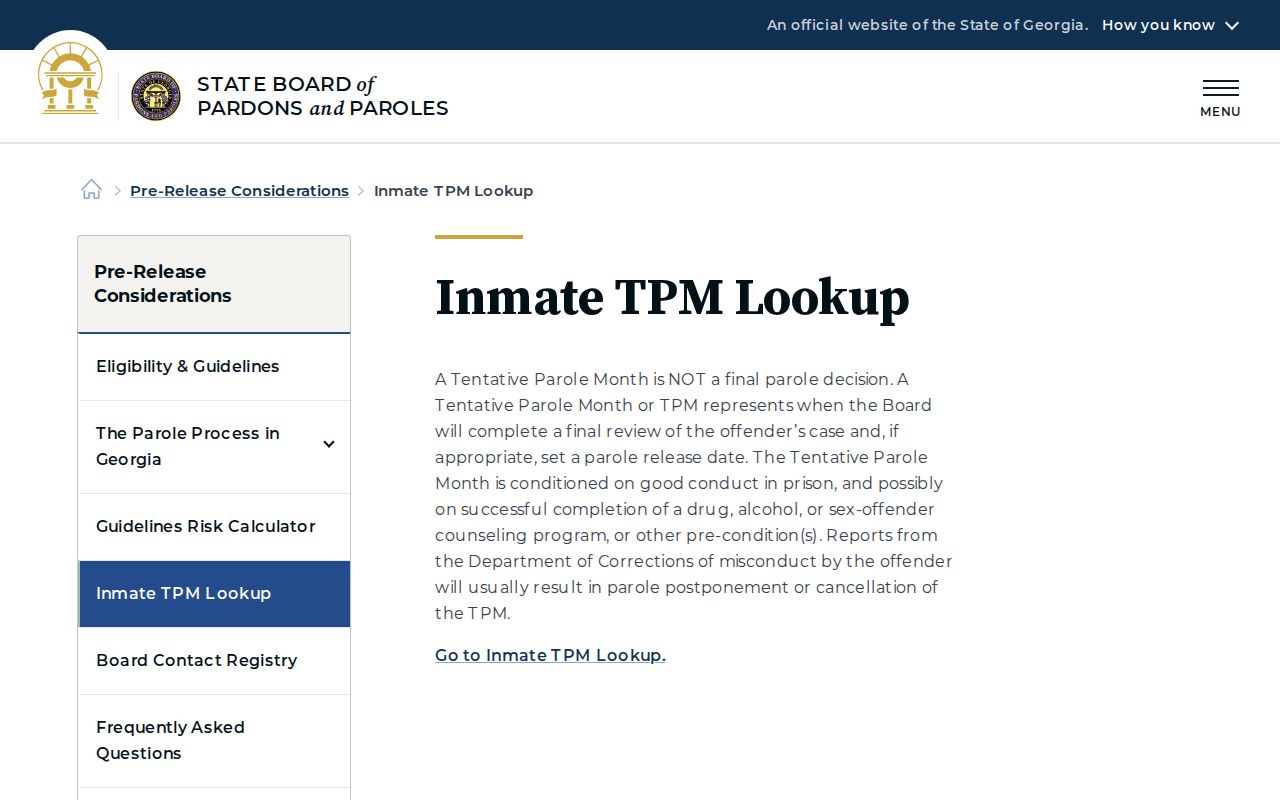
A TPM is useful for planning and follow-up. It is not proof of an actual release, and it does not apply to an ordinary Fannin pretrial booking.
Georgia Release-Date Limits
O.C.G.A. Section 17-10-6.1 restricts sentence reductions for specified serious violent felonies. Certain mandatory minimums cannot be suspended, stayed, probated, deferred, or withheld. Some covered sentences are not reduced through ordinary earned time, early release, work release, or leave, subject to the statute's narrow terms.
The serious-offense statute is shown below as a caution against applying a broad “good time” estimate to every Georgia sentence.
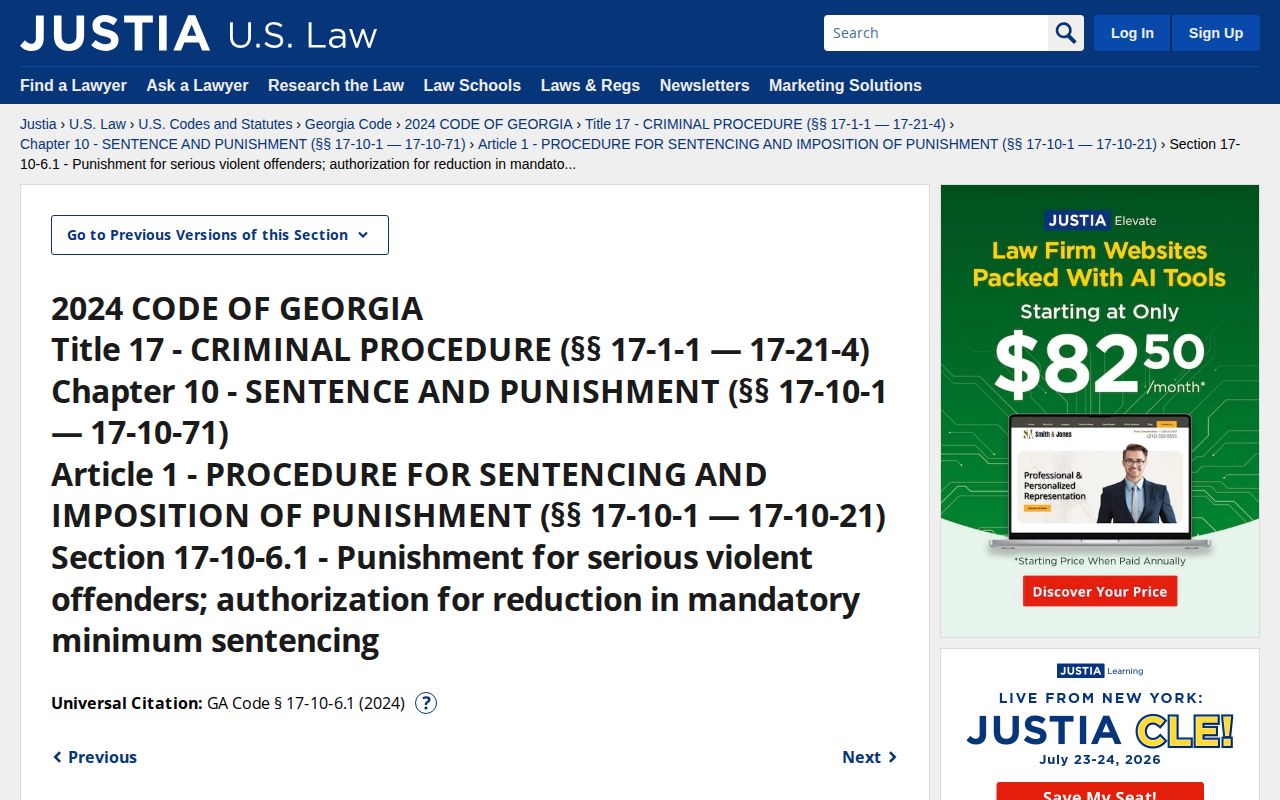
Eligibility depends on the offense, sentence, and relevant dates. The GDC record, Board action, and sentencing order must be read together rather than using a general percentage formula.
Federal Fannin Release Dates
No federal prison was found in Fannin County, but a local arrest or transfer can still lead to federal custody. The BOP federal inmate record guide says a future Release Date is projected from BOP calculations. A past date with no facility location generally indicates release from BOP custody, while “RELEASED” in the location field means the person is no longer held by BOP. Another custody system or supervision may still apply.
The federal record explanation is shown below because BOP date fields should not be confused with a Fannin jail or GDC date.
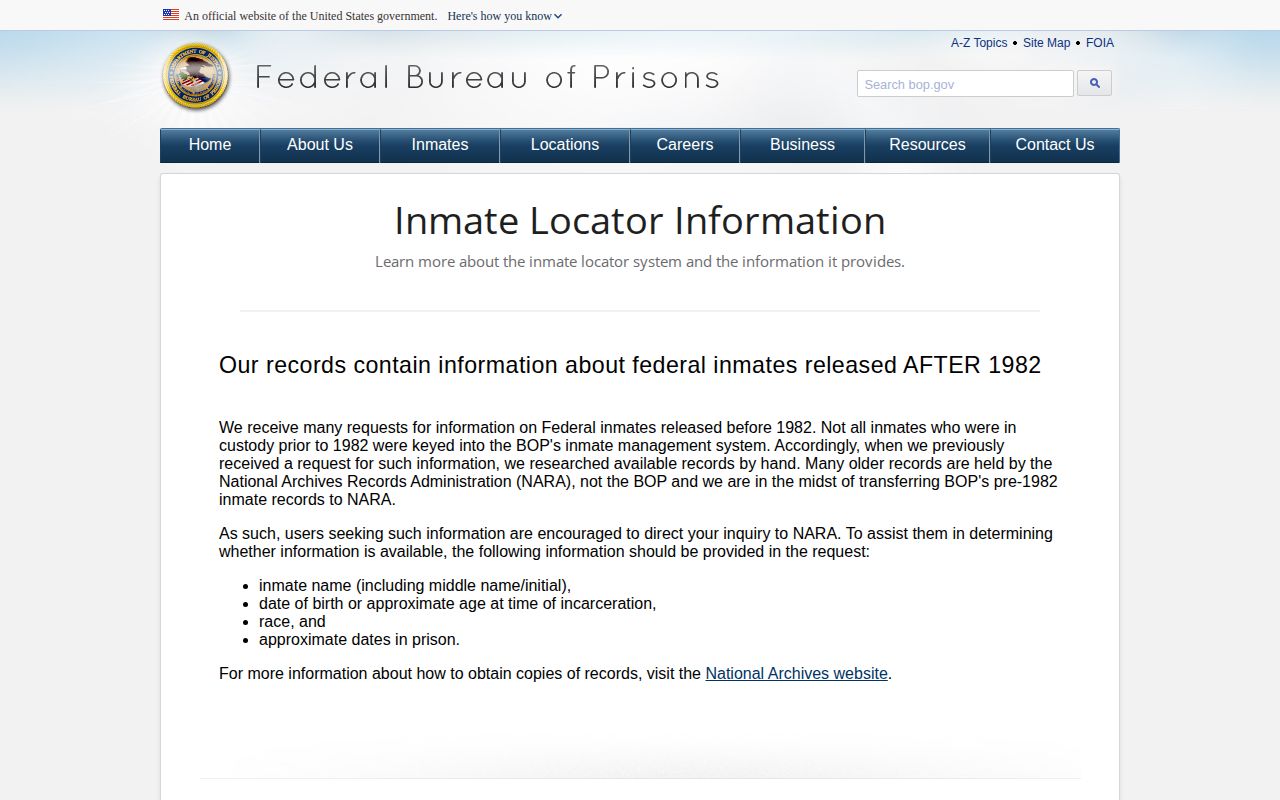
BOP notes that First Step Act recalculations can affect posted release dates. Use the federal locator for a federal sentence and the Fannin jail record only for the local transfer event.
Request Fannin Release-Date Records
If the online sources do not settle the date, request a narrow record from the office that owns it. For the county jail, ask for the booking or commitment record, discharge date, discharge order, releasing court, and whether the event was a community release or transfer. Georgia law requires the sheriff's jail record to include commitment and discharge information and makes that record subject to public examination.
For GDC, request public status, admission, facility, release or discharge date, release type, and relevant sentence date fields through the GDC Open Records Request portal. Medical, security, intelligence, and other exempt details may be withheld. For a court calculation, ask the Fannin clerk for the sentence and later modifying orders tied to the correct case number.
Georgia open-records guidance provides an initial response or timetable rule, not a promise that every record will arrive at once. A precise request reduces confusion and helps the office identify the specific custody term.
Use dates from court papers with care. A sentence date, sentence begin date, sentence end date, maximum release date, parole consideration date, and discharge date can all appear in one custody history. Each marks a different event. Jail credit can move the effective beginning of a sentence. Non-running time can extend a GDC calculation. A later court order can replace an earlier term. Copy the field label, agency, case or offender number, and the date exactly before asking for clarification.
For a Fannin county sentence, request the jail's public calculation or discharge fact rather than attempting to award earned time independently. Section 42-4-7 gives the authorized custodian the role of awarding earned time under the law. For a state sentence, use GDC and the Parole Board. For a federal sentence, use BOP. Keeping those lines clear prevents an estimated county release from being mistaken for a state parole date or a federal projected date.
Public Record Search
Sponsored Results